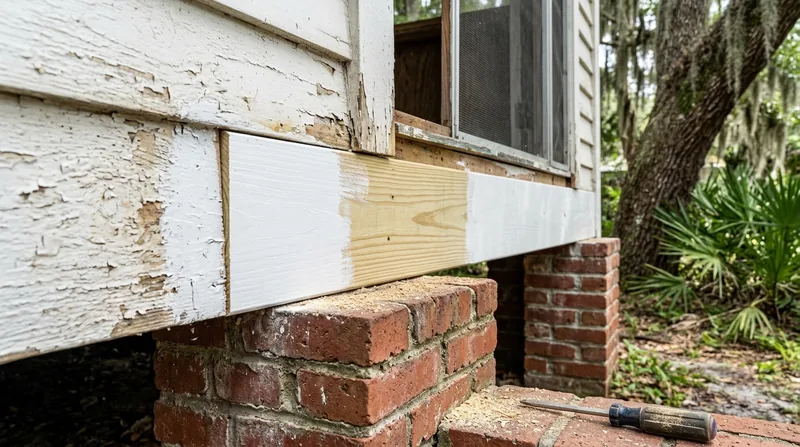




Jacksonville's humid subtropical climate and year-round moisture make wood rot and dry rot repair essential maintenance for homeowners across Riverside, Avondale, Springfield and the historic neighborhoods that define the city. Many of Jacksonville's most valued residences, built between 1900 and 1930, sit on ventilated brick pier foundations with exposed crawl spaces where moisture accumulates. The St. Johns River, its tidal marshes and tributary creeks create a persistently damp environment that accelerates decay in sill plates, rim joists, floor joists and exterior trim. We cut out decayed framing, siding and trim, treat the surrounding wood to arrest further rot, and rebuild with rot-resistant lumber. This is permanent repair, not a cosmetic patch, and it costs far less than replacing structural members or dealing with sagging floors later.
Why Wood Rot and Dry Rot Damage Jacksonville's Historic Homes
Wood rot thrives in Jacksonville's climate. Moisture enters through roof leaks, foundation seepage, failed caulk around windows and doors, and poor drainage around sill plates and rim joists. Once decay begins, it spreads slowly but steadily into structural framing, weakening the wood's load-bearing capacity and creating conditions for further water intrusion. Dry rot, a specific fungal decay that can spread even without standing water, is less common in Jacksonville but occurs in poorly ventilated crawl spaces and enclosed rim joists where air circulation stalls.
- Moisture trapped in crawl spaces under raised pier foundations accelerates rot in floor joists and subfloor.
- Leaking gutters and downspouts direct water against siding and foundation, saturating sill plates and exterior trim.
- Caulk failure around window and door frames allows water to penetrate into studs and header framing.
- Poor drainage and standing water in crawl spaces create persistent dampness that feeds fungal decay.
- Older homes in Riverside and Avondale often have limited ventilation in enclosed rim joists, creating ideal conditions for dry rot.
Addressing rot early prevents costly structural replacement and protects the integrity of historic woodwork that defines Jacksonville's architectural character.
Local context: Jacksonville's historic districts contain thousands of homes with exposed pier-and-beam foundations. These raised crawl spaces, a pre-air-conditioning design meant to allow air flow, now trap moisture and humidity that feed wood decay. A single soft sill plate or rotted floor joist discovered during a home inspection often signals broader moisture problems in the crawl space.
For guidance on moisture and structural concerns, homeowners can contact the City of Jacksonville Planning and Development Department regarding local building standards and permit requirements for structural repair work.
How We Repair Wood Rot and Dry Rot in Jacksonville Homes
We begin with a thorough inspection of the affected area, including the surrounding wood, to determine the extent of decay and identify the moisture source. Once we understand the pathology, we cut out all soft, discolored or crumbly wood, treat the sound wood around it with a fungicide, and replace the removed section with pressure-treated lumber or rot-resistant species like redwood or Douglas fir. For finish carpentry and trim, we match the original profile and grain whenever possible, so the repair blends seamlessly with the existing woodwork. The key is stopping the moisture at its source, or the rot will return.
- We inspect the damage and identify the moisture source that allowed decay to develop.
- We cut out all decayed wood and treat the surrounding sound wood with a fungicide to arrest further spread.
- We rebuild the removed section with rot-resistant lumber, sistered joists, or new structural members as needed.
- We address the moisture problem through improved drainage, caulking, ventilation or other measures specific to the site.
- For visible trim and siding, we match the original profile, grain and finish so the repair is invisible.
This approach preserves historic character while delivering a repair that lasts for decades.
Example: A homeowner in Riverside noticed soft wood around the base of an exterior door frame. We cut out the rotted studs and header, treated the rim joist with fungicide, replaced the studs with pressure-treated lumber, and installed new exterior trim and casing to match the original. We also sealed the gap between the rim joist and the foundation to prevent water from entering the crawl space. The repair cost $1,400 and took two days. Without it, water would have continued to seep into the floor joist, requiring a much larger repair within five years.
For more on structural framing repairs, see our framing and structural carpentry service page.
Wood Rot and Dry Rot Repair Methods
| Approach | Description | Best For |
|---|---|---|
| Localized decay removal and replacement | Cut out soft wood, treat surrounding area, install new lumber matching the original species and profile. | Trim, siding, small sections of rim joist or sill plate with decay confined to one area. |
| Sistering and reinforcement | Install a new beam or joist alongside a weakened structural member, bolting or nailing them together to share the load. | Floor joists, rim joists and beams where decay has reduced capacity but the member can still support temporary shoring. |
| Full member replacement | Remove the entire rotted joist, beam or sill plate and install a new one, using temporary shoring to support the load above. | Structural members where decay is extensive or distributed along the length, or where load-bearing capacity is compromised. |
| Crawl space moisture control | Improve drainage, seal gaps at the rim joist, install or repair vapor barriers and vents to reduce humidity and prevent future decay. | All rot repairs, especially in pier-and-beam homes where crawl space moisture is the root cause. |
| Exterior caulk and flashing repair | Seal gaps around windows, doors, trim and siding; install or repair flashing to direct water away from framing. | Preventing new rot from developing in trim, siding and door frames after the initial decay is removed. |
Wood Rot and Dry Rot Repair Cost in Jacksonville: What to Expect
Wood rot repair in Jacksonville starts at $650 for small, localized decay in trim or siding. A typical floor joist or sill plate repair, including moisture control, runs between $1,200 and $2,800. Full joist replacement with sistering and crawl space sealing can reach $3,500 to $6,000 depending on the span, access and whether temporary shoring is needed. Structural work such as beam replacement or load-bearing wall alteration typically requires a licensed structural engineer and a permit from the City of Jacksonville, and costs are quoted on estimate after an on-site inspection.
The main factors that move a repair up in cost are the extent of decay, the structural importance of the member, access to the work, and whether the moisture source requires significant remediation. A rotted rim joist in an easily accessible crawl space costs less than the same repair in a tight, low-clearance space under an old Riverside home. If decay has spread into multiple joists or the sill plate itself, replacement becomes more economical than piecemeal repair.
We always recommend getting 2 or 3 estimates from local carpenters. Prices vary based on crew size, equipment and scheduling. See our full pricing page for more detail on what drives cost and how to budget for repair versus replacement.
Wood Rot and Dry Rot Repair Near Me: What to Look for When Hiring a Contractor in Jacksonville
Start by verifying that the contractor is fully insured and can provide proof of general liability and workers' compensation coverage. Ask for references from recent wood rot and structural repair jobs in Jacksonville, and call at least two to confirm the work quality and timeline. Request an estimate in writing that details what will be removed, what will be replaced, what wood species or grade will be used, and what moisture control measures are included. If the scope involves a load-bearing wall, beam removal or significant structural change, confirm that the contractor will obtain a permit and that a licensed structural engineer will size any new members.
- Verify insurance coverage and ask for a certificate of insurance before work begins.
- Request references from recent repair jobs in Jacksonville and follow up with at least two calls.
- Get the estimate in writing, specifying lumber grade, species, moisture control measures and timeline.
- Confirm whether a permit is required for the scope of work and who will obtain it.
- Ask about warranty or guarantee on the repair, and what conditions void it (e.g., if the moisture source is not addressed).
- Check your homeowners association rules if you live in a planned community, as some restrict exterior repairs or require approval before work begins.
A reputable local contractor will welcome these questions and provide clear, honest answers. Call Jacksonville Carpentry at (904) 605-8456 for a free estimate and to discuss your specific repair with someone who has worked on hundreds of Jacksonville homes.
Wood Rot & Dry Rot Repair in Jacksonville: Pricing Guide
| Service | Price | Details |
|---|---|---|
| Small trim or siding repair | Starting at $650 | Localized decay removal and replacement in exterior trim, siding or door frame, includes fungicide treatment |
| Floor joist or sill plate repair | Starting at $1,200 | Single joist or sill section removal and replacement, includes crawl space moisture control and temporary shoring |
| Rim joist or multiple member repair | Starting at $2,800 | Larger scope affecting multiple joists or extended sill plate, includes sistering, fungicide treatment and drainage improvements |
| Beam replacement or structural alteration | On estimate | Scope requires on-site inspection, structural engineer sizing, permit coordination and temporary shoring design |
| Travel and estimates | Free and included | No mileage charge within Jacksonville and surrounding service areas, response within 24 hours of call |
Indicative pricing, the exact cost depends on square footage, finish, and site access. Free personalized estimate within 24h at (904) 605-8456.


